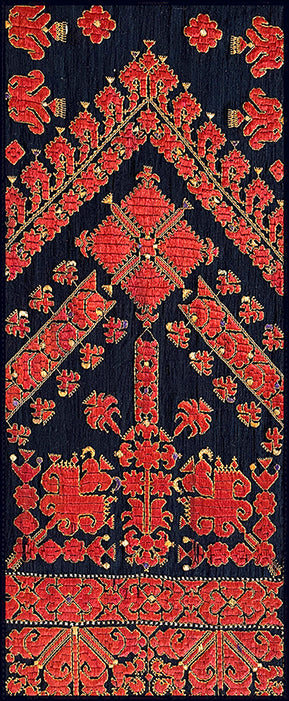
Woven Souls
*
As someone who loves Indian handloom textiles,
I feel the need to do the best I can, to contribute
towards finding a solution for the weavers.
Although I feel generally helpless in such large problems,
spreading awareness of their crisis and their weavings
is within my capability.

Article 1

An Ancient Indian Craft Left in Tatters
Sari Weavers Struggle Amid Economic Boom

By Emily Wax
Washington Post Foreign Service
Wednesday, June 6, 2007; A01


VARANASI, India -- Deep in a labyrinth of stucco buildings, in a dark, cavelike warehouse, Mohamed Javen, 18, switched on a light bulb, sat before his rickety loom and began working on what was once the prize possession of every Indian bride: the hand-woven silk sari.
His feet operated the bamboo pedals, making a rhythmic clopping sound. He carefully positioned hair-thin strands of gold thread into green silk, crafting a glittery lattice of leaves, elephants and birds that unfolded like a painting.
This sari design, which has been in Javen's family for 100 years, can take up to two months to weave. Patterns like these have been a source of Indian pride for more than 2,000 years, with India's version of haute couture adorning wealthy women of the empires of Rome, Egypt and Persia. Until recently, weaving was India's second-most-common occupation, behind farming.
But in this ancient city along the Ganges, Hinduism's holiest river, an estimated 1 million sari weavers are facing almost certain ruin. Cheaper, machine-made saris -- many of which are copied from Varanasi's famous patterns -- are being pumped out of China and from newer factories in India's western Gujarat state. Adding to the weavers' woes, changing fashions and global trade rules have opened the Indian market to foreign competitors, leaving many once-prosperous sari weavers and their families in desperate poverty.
"This loom will be in a museum," said Javen's despairing uncle, Nazir Ahmed, 30, whose family was forced to shut down 12 of their 14 looms. "We would have never predicted this. We were India's artists. Now we are living in poverty."
The new India is home to smooth highways and shiny high-rises, all the accouterments of the developed world. But millions of craftsmen, manual laborers and rural workers are being left out of the economic boom. Nearly 70 percent of India's population lives on less than $2 a day, and with more than 40 percent of its young malnourished, India is worse off than Africa in terms of children's health, according to the United Nations.
India also lacks a social security system, leaving weavers, farmers and others vulnerable to market forces. It is a gaping hole in India's rush to become a developed country that Indian Prime Minister Manmohan Singh has pledged to fix.
"This is the ugly, painful side of globalization. It's a real crisis. If India is booming, you don't see it among weavers or farmers or other rural laborers, which is to say most of the country," said Lenin Raghuvanshi, head of the People's Vigilance Committee for Human Rights, an aid group here. "Helping those left behind is India's greatest challenge."
Few professions in South Asia were as esteemed as that of the sari weaver -- part artist, part craftsman. Using simple foot-powered looms, weavers for generations have fashioned elaborate patterns and scenes of weddings, mango groves and Mughal processions, replete with elephants and horse-drawn carriages. Their canvases are billowing sunflower and saffron silks, each six yards long.
The father of independent India, Mohandas Gandhi, clad in his homespun loincloth, launched his nationalist movement to defy colonialism by encouraging Indians to stop wearing cheap British machine-made cloth in favor of Indian-made fabrics, partly as a gesture of self-reliance. The hand-loomed saris from Varanasi became a national symbol for India's independence.
But today, the decline of the sari industry has had tragic consequences. In the eastern villages and cities of Uttar Pradesh state, 175 weavers committed suicide last year, despondent over their recent change in fortunes, according to the People's Vigilance Committee. About 70 percent of weavers' children are malnourished, aid groups estimate. The weavers also cannot afford basic medical care for their children, much less themselves.
That's how Razia Khatoon, the wife of a once-prominent weaver, last year ended up a stranded widow with nine children to feed.
In her village just outside Varanasi, Khatoon said customers stopped buying handmade saris several years ago. She had to sell the gold she received at her wedding, the Indian equivalent of hocking a diamond engagement ring. Soon after, she married off her two oldest daughters "just so that they could be fed somewhere else," she said.
Her husband, Mohammad Ismail, 50, became more and more distressed as profits from weaving continued to dwindle. He also had contracted tuberculosis and was unable to pay for the medicines needed to treat the disease.
"The saris he wove were meant for queens and princesses," she said. "But everything changed. He started to wish he taught his sons more useful skills."
Ismail died in July 2006, Khatoon said. Traumatized by her grief and her new financial pressures, she sat with his body through the night, as her children hugged her.
"I was afraid of the future," whispered Khatoon, 45, red-eyed as she recalled Ismail's death. "Then everything got worse."
Early this May, her pretty 20-year-old daughter, Ruksana, also died of tuberculosis. Now the disease is set to claim her 16-year-old daughter, Salma, who rests limply on a straw mat outside her family's shanty.
What makes the deaths of Ismail and his daughter so surprising is that the weaver's family was always self-sufficient.
Likewise, Ramzam Ali, 32, is the first weaver in five generations to have trouble feeding his family. "I rush every morning to find work as a rickshaw driver or as a day laborer, but there are already so many people already doing those things," Ali said. "If I can't manage to even feed my children, how will I mange to educate them in a different trade?"
Part of the problem is that Ali has a fifth-grade education and no other skills. His father taught him how to weave intricate patterns of lotus flowers and animal motifs onto silk. That's all he ever thought he would need. Now, he joins more than 370 million other Indians in the informal jobs sector, many of them illiterate, unskilled and in dire need of work, according to government studies.
Aid workers trying to help the weavers say the industry desperately needs a marketing campaign. They are talking to Bollywood stars about showcasing handmade Varanasi saris on film while also trying to market the handmade sari to the middle and upper classes as the "little black dress of India" in fashion magazines.
But the campaign has been slow, partly because of greater interest in Western fashion.
In the new Indian metropolis, casual, machine-made cotton kurtas, or shirts, have become the preferred attire of the young; long and colorful, the shirts can be worn over jeans. But as India's markets open, Western fashion outlets like United Colors of Benetton are being flooded by India's young middle class, eager to show the urbane hipness that distinguishes them from their parents.
Despite the boom in many information technology hubs in southern Indian cities, Varanasi's weaver quarters look like a ghetto, with men sleeping under broken-down looms strung with cobwebs, rutted streets with trash fuming at every turn and donkeys hauling in water for cooking and bathing, tugged along by barefoot urchins.
"I hardly care about booming India when I have no food or money," said Poochland Dash, 60, a white-haired grandfather and a once-wealthy weaver who said through tears that he is considering suicide. He is trying to sell the house he built during the golden years of the sari-weaving industry, with his saris featuring embroidery of men atop animals in rich indigos and reds.
"If a buyer insults me with a too-low price, I swear I will kill myself," Dash said.
Listening nearby, his wife started crying. "If he takes his life, I will take my life, too," she said, staring at the ground.
Special correspondent Indrani Ghosh Nangia contributed to this report.

Article 2

25 February 2008
------------------------------------------------------
INDIA: Four-year-old boy died from malnutrition in Uttar Pradesh
ISSUES: Right to food; failure of government health service; corruption; criminal neglect
------------------------------------------------------
Dear friends,
The Asian Human Rights Commission (AHRC) has received information regarding the case of four-year-old boy, Khusbuddin, who died of acute malnutrition in Harpalpur village of Kashi Vidyapith Block, Varanasi district in Uttar Pradesh state. The AHRC has been informed by the People's Vigilance Committee on Human Rights (PVCHR), a local human rights organisation working in Uttar Pradesh state that Khusbuddin was suffering from Grade IV malnutrition which resulted in his death.

CASE DETAILS:
Khusbuddin died of malnutrition on 6 February 2008. Khusbuddin was four years old and the son of late Mr. Mohammad Matin. Khusbuddin was suffering from Grade IV malnutrition.
Khusbuddin was living with his father Mohammad Matin, mother Jaharun Nisha and elder sister in Mirzapur district. After his father's death, Khusbuddin's family moved to his maternal grand parents' home in Harpalpur village, Kashi Vidyapith Block, Varanasi district.
Khusbuddin was identified to be suffering from Grade IV malnutrition, weighing 6.5 kilogram at the St. Mary's hospital in Kourata. Khusbuddin's mother Jaharun was too poor to get Khusbuddin treated at the private hospital. On 5 December 2007, Jaharun took Khusbuddin to the Primary Health Centre (PHC) of Kanai Sarai in Kashi Vidyapith Block which is about 12 kilometers away from Khusbuddin's house. Jaharun had to walk to the PHC since she could not manage the bus fare.
However, the officer at the PHC did not provide any medical attention for malnourished Khusbuddin saying that there was no medicine at the centre at that time. Neither did Khusbuddin receive any food at the PHC. Jaharun could only give Khusbuddin some water and sugar on that day.
After Khusbuddin's death, Dr. A.K. Sahaye of the PHC and Mr. Manish Srivastava, Block Officer in charge of UNICEF programme visited Khusbuddin's house and tried to obtain Jaharun's signature forcibly on a paper certifying that Khusbuddin did not die of malnutrition and was not ill-treated at the PHC. Since they failed to obtain Jaharun's signature, they asked her neighbour to write her name on the blank paper.
It was reported that the Auxiliary Nursing Mother (ANM) of Anganwadi Centre (child care centre) of Harpalpur village who is supposed to be responsible for the health care of the children has never visited Khusbuddin's house and has denied any support to the  family so far. It was also reported that after Khusbuddin's death, the village head Mr. Salim delivered 1000 Indian Rupees (USD 25) to the victim's family under the order by Chief Secretary of Uttar Pradesh. This is the only support Khusbuddin's family has received from the government so far.

BACKGROUND INFORMATION:

Harpalpur village is 9 kilometers away from Varanasi city. The village is predominantly occupied by Muslim handloom weavers. Like other weavers' communities in Uttar Pradesh, many weavers in Harpalpur village also had to leave their profession due to the decline of handloom weaving industry.  As of now many of such weaver families are suffering from starvation.
Khusbuddin's father Mohammad was also a weaver. After Mohammad death, Khusbuddin's mother Jaharun has been doing embroidery on dupattas (long scarf). This would earn her about 20 Rupees (USD 0.5) in two day's time. Jaharun finds it difficult to manage the daily food for the family with this income. Khusbuddin's elder sister however is provided mid-day-meal from the primary school where she attends.
Despite the extremely poor living condition of Khusbuddin's family, the red ration card (Antyodaya Anna Yojana Card) was never issued to this family. Khusbuddin did not get any support in order to escape from hunger. The Anganwadi centre, which is the key in delivering the Integrated Child Development Services (ICDS) is neglecting their work in Harpalpur village. The ICDS targets children aged six years or below.
The health workers of the Anganwadi centre have important and direct roles to prevent the poor children and women from starvation and ailments related to starvation and malnutrition at the village level. All the ICDS services are provided through the Anganwadi workers in an integrated manner to enhance its impact on child care.
Under the ICDS, the Anganwadi workers should visit the village regularly to carryout health check-up for the children. Once they identify a malnourished child, the child has to be registered at the Anganwadi centre in order to provide nutrition and health care for the child until the child's condition is safe. However, like the case of Khusbuddin, the negligence of the Anganwadi staff at Harpalpur village is one of the main reasons that result in starvation deaths in India.
The case of Khusbuddin explains that the negligence of the medical officers at the PHC accelerates not only infant mortality in India but also facilitates corrupt practices to hide data regarding infant mortality. In addition, it is a common practice in India to conceal deaths from starvation as was sought to be done both by the doctor at the PHC and the Block Officer. This fact is noted in the most recent report of the UN Special Rapporteur on the Right to Food. This report was prepared by the Rapporteur immediately after his visit to India.
The AHRC has issued similar cases in the past from India concerning the failure of the public health system. The poor condition of the PHC in Kashi Vidyapith Block also was exposed in previous Hunger Alert


Article 3

Death knell for handlooms?

SABITA RADHAKRISHNA
The Hindu Magazine
 
Hand-woven fabric is the product of Indian tradition, the inspiration of the cultural ethos of the weavers. With its strong product identity, handlooms represent the diversity of each State and proclaim the artistry of the weaver. It is not thread al one but the weaver’s imagery, faith and dream that create heritage fabrics which have undoubtedly placed India on the world map. Handlooms rank second only to agriculture as an industry. The handloom sector boasts of 3.4 million weavers according to a census conducted by The National Council of Applied Economic Research (NCAER) in the year 1995-96 whereas in 1987-88 it was 4.3 million and the drop of nearly a million is all too significant and in the present scenario rather bleak.

The Kancheepuram sari with its korvai designs may become a museum piece sooner than we think, so also the cotton korvai saris, with the weavers disinterested in weaving them. A cotton sari fetches the weaver Rs. 270 per sari as against Rs. 2,500 for a silk sari. A master weaver in Kancheepuram quotes the example of an MNC which sends buses to pick up young adults who are the children of the weavers. Even if it is an unskilled labourer’s job, he can pick up around Rs. 250-300 a day and what’s more, there is “prestige” attached to a factory job! What’s worse is that our Southern traditional weaves are being pirated through importing weavers from Tamil Nadu. For most handloom weavers it means sitting at a loom for 12 hours at a stretch and even longer if it is festival or wedding season. Many of those interviewed swear that they will not subject their children to work in a profession which drains them. Most of them develop orthopaedic problems and then it is too late to move to other professions when they are past the prime of life.

Indirect impact
“The adversities that the farming sector continues to face have considerably affected the survival of many subsidiary activities and are a strong contributing factor for the downfall of the weaving industry. This indirect impact cannot be ignored,” says Dr. Shyamasundari of Dastakar Andhra. “While the weavers have encouraged their sons to be educated in professional courses, they have overlooked the fact that actually it is weaving that supported their education making them engineers and doctors.”
That the exodus of young handloom weavers from their traditional occupation is steady is all too apparent. Cheaper synthetic fabrics flooding the market is one of the reasons and of course the failure to access and adapt to newer markets. The market which was originally located in rural areas has shifted to urban areas. The weavers were selling their products to co-operatives but it is these co-operatives who have not been able to locate ready markets.
One of the interventions by the Government is the Swarnajayanti Gram Swarozgar Yojana (SGSY), specially formulated to help the 19,500 weavers engaged in the production of low cost saris and dhotis for Free Distribution Scheme (FDS). The weavers, who in the past were capable of creative weaving, sank into a blissful state of complacency, knowing fully well that whatever they wove, or however bad the quality, it would be accepted. The number of saris and dhotis woven were much more than the number of beneficiaries and as a result, the godowns of Co-optex began to swell with stocks of these saris and dhotis. Consequently, the FDS had to be discontinued in 2001.

Left stranded
Nearly 19,500 weavers were rendered jobless and faced severe socio-economic problems. Highly skilled weavers, like the ones from Virudhunagar, who were weaving 80s by 120s, did not know how to recall their skill. It was a time of great unrest and these handloom weavers were in a state of flux. It was a Catch 22 situation. With powerlooms dominating textile production all over India, and encroaching on the handloom sector’s traditional market, the handloom weavers, in a desperate situation, drifted towards powerlooms, finding that work here was an easy substitute. Children were sold as bonded labour to bosses and without money to release them the bondage looked permanent. They went into building construction and brick making besides other jobs. Even older weavers took to new occupations and traditional skills were fast languishing. The situation looked grimly bleak.

A proposal was charted out for a special project which would help these weavers learn new skills, regain lost ones and gain exposure to the countless possibilities of fine weaving and the project planned in different stages such as identification of the project implementing agencies, skill and technology upgradation, entrepreneurship development, and infrastructure development. The State Government sanctioned 25.36 crores for the Project. NIFT became the implementing agency. Training has been imparted to the weavers and new designs have been developed in saris, dress material, shirtings, and household linen. New markets were located as also export markets.
With the government doing what it possibly can, beneath all the fluff, there are layers of discontent voiced by the weavers. The main grouse is the fear that they would be left midway with new schemes that they find bewildering and the inability to access new markets based on past experiences. Besides, the psychological impact that a complete turnabout would bring is not really understood by the so called guardians of the traditional vocations. A great degree of sensitivity is required when working in these areas.

Pawns in a game
Cut to the Varanasi weavers. A BBC World TV broadcast focussed on the plight of weavers in Varanasi facing the impact of Chinese “Benares brocade saris” imported at a fraction of local prices. Again this is a story of utter poverty and despair and the weavers not wanting to remain tied to a crippling tradition. Thousands of weavers around Varanasi became pawns on the chessboard of a capitalist system of merchants, brokers and bureaucracy.
Vilas Muttemwar, Congress Lok Sabha member from Nagpur, raised the plight of the region’s weavers in Parliament, saying about 20 lakh weavers in Vidarbha were seriously hit by the government’s “casual ad-hoc policy and unhelpful attitude” towards problems relating to supply of yarn, credit support and other related facilities. “As a result, a large number of weavers are on the brink of starvation,” he maintained.

Uzramma of Dastakaar Andhra says that the handloom industry portrays a vibrant scenario even though it is in a state of flux. “The point to be made is that the State does not recognise its tremendous potential, not only for rural emloyment, but as a viable economic activity which does not need the huge investments of infrastructure and capital which conventional industries require,” she says.

So what are the options left to craft activists who are concerned at the plight of the weavers and a craft tradition which is languishing? Says Ashoke Chatterjee (former President, Crafts Council of India), “our finest craft skills need immediate protection, which means reaching the weavers at the apex of a pyramidal supply chain. The active participation of the trade is recommended, difficult though this may seem in the light of current attitudes and past experience. The present condition of decline in weaving reflects the changing social structures, values and most importantly changing markets. Simultaneously, working with authorities, NGOs and activists in and around Varanasi, or other affected areas, one could attempt a relief fund to address immediate survival needs of families affected by death, debt and starvation.”

The only solution as I see it is to lobby for the languishing craft and handloom weaver through press reports, the electronic media, plays, short films and whatever is needed to address the existing problems. Our Indian fashion designers have a wealth of traditional material to dip into and they could harness traditional skills to showcase their designs which could give the Indian weaver exposure in international markets.
Without action the death knell sounds loud and clear.
The Hindu – Magazine
http://www.hindu.com/mag/2007/11/11/stories/2007111150280700.htm


If you have any ideas or thoughts that might help the communities, please
write to me - maybe together we could do something

jaina@wovensouls.com
*
window

back